Friday, January 13, 2012

Three Cheers for American Bureaucracy!

Our country director sent out her weekly update today. In it was a link to the FVAP – Federal Voting Assistance Program. It’s a program designed to help Americans living overseas in the armed forces or any other capacity exercise their right to vote. I went online and filed my request for absentee ballots for all of the elections in my voting district for the upcoming year. I was able to select a preferred method of delivery – email, mail, or fax. It was simple and fast – about two minutes.
Except for applying for passports, I didn’t have many encounters with government bureaucracy until I reached the age of 65. Then came Medicare and, a year later, Social Security. I have to say that all my dealings with those agenciess have been positive. Efficient, friendly, helpful, and respectful people and pretty straightforward and clear procedures. And now this. It’s enough to make a citizen happy.
I compare that with my experience here in Morocco.
After I was sworn in as a Peace Corps Volunteer last May, I had to apply for a carte de sejour (residence permit). That required 10 passport sized photos (can’t imagine why, since the card itself has only one), an equivalent number of photocopies of my passport, attestation de travail (work certificate) and attestation de residence (certificate of residence), several tax stamps, three trips to the Royal Police office (gendarmerie), and one to the city hall to get all of them notarized. After I finished the application, I received a receipt, which I had to carry with me at all times. During the period while I was waiting for my card, I had to return and get the receipt renewed every month. That took five months, which meant five more visits to the gendarmerie. For me, that meant only about three hours out of my day each time. I’m fortunate. For some of my Peace Corps friends, that means a whole day and travel by bus or taxi to a distant city. I’m also required to inform the gendarmes whenever I’m going to be away from my site overnight.
So I say, “Three cheers for the American bureaucracy!” It’s a snap compared to what I face here.
P.S., I didn’t really forget that I have an encounter with the bureaucracy every year on April 15. I’m not really looking forward to filing my taxes from Morocco for the first time, but I actually think it’s going to go all right. Filing taxes is not so straightforward. Like many people, I get help with it. But, you know, that’s not really the fault of the bureaucracy. It’s the fault of those politicians who, as either policy or payback, have created all the windfalls and loopholes in the tax code.

Monday, January 2, 2012

Christmas in Morocco

My artisan-made cookie cutters
When I first tried to explain to my host family that Christmas was coming, they said “Bonani?” I did an off-the-cuff etymology of the word and figured it was a borrowing of the French bonne nuit (good night). So I said, yes, I thought so. Of course, I was wrong. It’s actually a borrowing of the French bonne annee (Happy New Year).
For several days we went along in blissful misunderstanding. When I finally realized the mistake, I explained to them that, no, Christmas was a different holiday, always a week before bonani, and it was big, the biggest American holiday of all. I said it was comparable to Leid Axatar. My host father said, “Do you slaughter a sheep?” I said, no, that we traditionally eat turkey. “Skram,” he called me – “cheapskate.” We had a big laugh.
A plate of cookies I made up for Sulayman, my host nephew,
who was still at school when the party started
But I set about preparing a celebration for Christmas, which was clearly totally unknown to them – in fact, I have yet to discover what the word for it in Tamazight is, if it exists at all. A friend in the States sent a tiny tree with tiny lights and tiny ornaments. I had one of my dagger-maker brothers make some cookie cutters for me. Two of my Peace Corps friends came to my house and helped me get everything ready for the little feast.
The afternoon of the 23rd, my host family (10 of them, anyway) came over. We had Christmas music playing and served cookies (frosted Christmas cookies, oatmeal, and jelly-filled) and apple cake, along with hot chocolate. After eating, I explained that gift-giving was also a Christmas tradition. I gave them each a pair of good socks filled with apples and oranges, M&Ms and candy canes. They were thrilled. “Not skram,” my host brother said.
My tiny tree with some presents for America around it.
The next day, one of my friends and I went to another PCVs house to celebrate the holiday with Americans. There were seven of us in all. We each contributed a dish and had a real feast – a chicken tajine, mashed potatoes, green beans, deviled eggs, cauliflower-cheese pie, apple cake and apple sauce. We went for some long walks in the countryside around their house and played games. I must say, it’s fun and a great comfort to be around countrymen and women at times like this.
On the 27th a friend and I took off on my first real vacation in Morocco. I’ll fill you in on that in my next blog. I know I keep promising that. This time I’ll keep it.
Bonani!
A potted olive tree with homemade decorations made a
great stand-in for an evergreen at our PCV Christmas

My contribution to the Christmas tree decorations


Our PCV group on one of the hikes

I visited a manger and found sheep. The mother fretted
a bit.

Our PCV feast.

Friday, December 9, 2011

Surf, a Spelling Bee, and IST

Sunset over the Atlantic
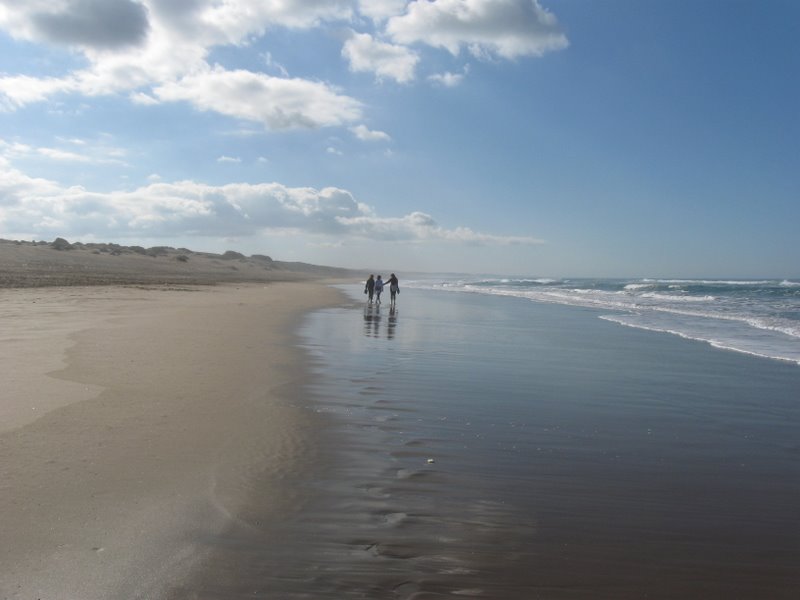
We arrived in Mehdiya last Sunday after dark. Though I couldn’t see the ocean, I could smell it. When I went to sleep that night, I went to sleep to the sound of surf for the first time in nine months. And when I got up in the morning and looked out my window I saw a broad beach, a long breakwater reaching out into the ocean, and what looked like a dredge working at the mouth of the channel. It reminded so much of Grand Haven and my home on Lake Michigan.
Walking the beach with a friend, Adam, during
lunch break
The fifty-two remaining volunteers of the 60 who started with me (eight have ETd – early terminated – for personal or medical reasons) all converged on Mehdiya, a beach town a little north of Rabat. The occasion was IST (In-service Training), held six months after swearing in for each staj. On our first day, we had another LPI (Language Proficiency Interview). I did all right, moving up one notch to Intermediate Mid. At least I’m moving in the right direction! The next day, we shared our experiences so far and our plans for the next phase of our service. That was followed by a couple of days of workshops on grant-writing and teaching ESL (English as a Second Language).
I feel lucky. Many PCVs are still “integrating,” but I have plenty of work with my three days a week teaching in the elementary schools, plus work at the sbitar, middle school health club, and with the women’s association I’m helping get started.
Going through the rules prior to the start of the
IST Spelling Bee
I’m also working on a new project – Spelling Bee Morocco – that I hope will eventually create a national spelling bee for Moroccan students. I used the gathering at IST to present the idea to my fellow PCVs, and we held a late-night Spelling Bee at 10:00 p.m. on Wednesday. Fourteen PCVs participated and about 20 others formed an audience. Much to my surprise, very few of them had ever participated in a spelling bee back home. But they’re a bunch of smart, confident people, and they really got into it. It took eleven rounds to crown a winner. She won on “hippopotamus” and “aggraded” after the runner-up stumbled on “euphemism.”
The winner and a disconsolate runner-up
IST has ended. We’ve just had dinner. There will be a “Souk Prom” later tonight. And tomorrow morning, we’ll all head back to our sites. This is the last time all of us will be together at the same time until our COS (Close of Service) conference, a few months before we complete our Peace Corps service, so there’s a bittersweet tinge to the evening.
I spent a day in Marrakesh on my way here, and I’ll be spending a couple of days in Rabat on my way back home. I’ll tell you all about that, and some other travels I’ve taken in the last couple months, when I get back to my site next week.

Mehdiya has a beautiful wide, flat beach


Work boats entering the channel at dusk


Thursday, November 24, 2011

A Challenging Question and a Rain Day


A French association is building this well at one of
my schools.

A Challenging Question
At school this week, while I was having tea with the teachers during recess, one of the teachers asked me what my goals were. I naively thought he was asking about my personal goals. Because my language is limited, I gave a simple answer – that I wanted to help people.
I had misunderstood. “But what about your organization,” he said, “will it do something to help us?”
I said, “I guess I’m the help.”
He didn’t exactly guffaw, but he did get a smile on his face. “But that’s just words,” he said, referring to my teaching, I suppose. “We already know that stuff. But will it do something to help us?”
“You mean money?” I asked.
Rain shrouds the Dades Valley today
He nodded, then proceeded to tell me that a French association had dug a new well for the school and that another French association had planted some olive trees.
This was my first personal encounter with such a direct “show-me-the-money” attitude. I have some thoughts about it, but I’m curious to know what yours are and how you would respond to such a situation. I may be opening a can of worms by soliciting your opinions, but I’d really like to know.
A Rain Day...
Water cascades down a path we
usually walk.

I woke this morning before my alarm to the sound of rain spattering in the courtyard and pattering on the roof. I got up and went through my usual morning routines, then got ready for school. When I went outside I saw puddles standing in my front yard - a first for puddles there. When I rode down the narrow path between buildings and turned the corner I was astonished to see a torrent of red water rushing down the wadi below my house. I’d never seen water in it before. I pedaled on along paths that were fairly slick with mud and filled with water in the ruts. When I got to the main road, a piste (dirt and gravel), streams of water were running down the two tracks. I was already pretty wet and pretty cold. I dearly wished for the gloves I bought at souq yesterday and promptly lost.
I began to think about how miserable I was going to be in class, cold and wet in the unheated schoolrooms, trying to be energetic and interesting to kids who were probably also cold and wet and hunched up braving the cold. But then salvation occurred, of a sort. I got to the bottom of the hill that separates my town from the neighboring village and another torrent, about ten yards wide and a couple of feet deep was rushing across the road. I’d never seen water here before either. I got off my bike and studied the terrain to see if there was a place where I might wade across. None in sight. Even if I did make it across, I still had another two kilometers to go. I knew there were a couple places ahead that habitually turned into streams during a rain. I figured they would be full too, and decided to turn around and go home.
The road was flooded and there was no good place to
ford the stream
There’s no phone at the school and I didn’t have any of the teachers’ cell phone numbers. I felt bad that I would just not be showing up, but I hoped the teachers would figure out what had happened. Shortly after I got home, Rachid and Fatima, one of my host brothers and sisters, knocked on my door. They came in, shoulders hunched, muttering “asmid” (cold) and “tagut” (rain). While we warmed ourselves over glasses of tea I told them I hadn’t gone to school because of the rain.
“Oh, there’s no school today,” they said, “not with a rain like this.”
In Michigan, we get snow days off when the snow makes it impossible or dangerous to go to school. I never imagined that here in Morocco I would get the equivalent – a rain day. And just as I would if it were a snow day, I’m reveling in it. At this moment, I’m bundled up in dry clothes, sitting at my desk, with a little space heater –the only non-sun-assisted heat in this large house of mine – warming my feet. I’m toasty, and the burden of guilt I was feeling for not showing up at school has been lifted from my shoulders. A rain day. Another thing to be thankful for on this Thanksgiving Day.
Leaves are changing color...
…and Other Stuff
It’s fall (lxrif) here, just as in the States. The weather has definitely changed. With all the precipitation of the last week, the Atlas Mountains have acquired a mantle of snow they won’t shed till next April or May. Here in the valley, the leaves have begun to change and fall. And, though it seems like just a few weeks ago that I was sleeping with just a sheet over me, I now wear longjohns and flannel pajamas to bed and I’ve discovered why people in the olden days used to wear sleeping caps and socks. Yesterday at souk, I bought a knit cap to keep my bald head warm at night and also bought two more blankets to add to the two I already had. I think – I hope - that’ll be enough.
Here’s a link to Peace Corps Postcards, a project to celebrate the 50th Anniversary of the Peace Corps. In it you’ll find some short videos of current Peace Corps Volunteers and see what wonderful, creative work they do. It includes two “post cards” from Morocco, one of a hip-hop group, another of a baseball team.
Oh, and Happy Thanksgiving to you all!
The fig trees shedded their leaves in just a few days. Townspeople have
gathered them and chopped them up for animal feed. Not much goes
unused here.


Fall means pomegranates, limes, these small oranges
(about the size of a lime), and apples are in season.


My house revealed its leaks this morning - several
of them. Fortunately, like this one, they were all
over bare concrete.


The preferred method of sweeping is with this natural broom
called ifssi - not surprisingly, the word for shrub.


The Atlas Mountains are capped now in snow, probably till April or May.


Thursday, November 10, 2011

A Meat-Only Diet

The hair has been burned and scraped off the cow's skull,
which will later be chopped into pot-sized pieces
and used in a stew.
Sunday morning I went to my host family’s house to help slaughter a cow. Since then I haven’t had a thing to eat but meat. I’d heard stories about what a rough week this is for vegetarians (not that I am one), but I had no idea.

We killed the cow at 9:30. By noon, we were eating it as shish kabobs. An hour and a half later, we had lunch of stewed meat and juices. For dinner that night we again had a meat-only duaz with liver and beef shish kabobs as appetizers. And all week long, whenever I’ve visited people, I’ve been served shish kabobs with tea rather than the usual peanuts and cookies or bread. Not until Wednesday evening, when I had dinner at another friend’s house, did I even see a vegetable – a little bit of carrot and a few chunks of turnip in a large plate of meat.
It was not a big cow, but it's still a lot of animal. All parts
of the animal are eaten, including the innards, head, and feet.
By “rough week,” I mean the week of Eid Akhatar (big feast), Eid Kbir in Arabic, also sometimes called Eid Al-Adha (the Festival of Sacrifice). It commemorates Abraham’s sparing of his son and sacrificing a ram instead. After Ramadan, it’s probably the most important festival on the Muslim calendar. It takes place 70 days after the end of Ramadan, which was Monday. By tradition on that day the male head of every household sacrifices an anogod (ram). Then the family spends the rest of the week eating it. Our family did that, too, on Monday, but because it is such a large family, I guess Mohammed decided to slaughter a cow as well as a sheep.
My main job was to take pictures, but here I'm helping roll
the carcass so that others can separate the skin
from the top of the cow's back.
I had no idea of the sheer effort, strength, and time it takes to skin and butcher a large animal with just knives and a hatchet (no power saws here). With the cow, we started at 9:30 and finished at noon. By “finished” I mean we’d quartered the animal. We didn’t actually finish cutting up all the meat till Wednesday morning. And the whole family was involved. As with Ramadan, there is a lot of anticipation of the festival. And while I wouldn’t say it was a party atmosphere, it certainly was a joyous one. Those who weren’t helping with the butchering were watching and talking. And when it was done, of course, we ate.

The anogod hung, first to be "undressed,"
i.e., have its skin peeled off like a sweater,
then to be "dressed," as in butchered.

Monday was similar, except that after breakfast, the men first climbed the hill outside town and took part in a prayer service. After that, we came down to the house, changed out of our good clothes, and slaughtered the ram. And then we had shishkabobs and a lunch of meat.
I’ve talked about meat, but the festival is much more than that. It’s really about gratitude and thankfulness and the bonds of family, friendship, and community. It’s kind of like our Christmas and Thanksgiving rolled into one. Families draw together. The men who work at jobs in one of the big cities, or even abroad, come home, and there’s lots of visiting among neighbors, friends, and relatives. There was a steady stream of people to my family’s house on Monday, and on Tuesday and Wednesday I spent a good deal of time making the rounds myself.

Shishkabobs with fresh herbs and spices have been a staple
of the Leid diet.

I’m not quite sure what marks the end of Leid – maybe when the sheep is eaten up? – but I’ve begun to dream of vegetables.

Wednesday, October 26, 2011

I Have a Dagger

 
The silver dagger at the top and steel dagger in the middle are by
Mohammed. The leather-wrapped dagger is by Houcine.
They range from 16" to 18" long.


Mohammed at work in Shop #34 of the
dagger makers' cooperative in Kalaa,
a space he shares with Houcine.
Tok, tok, tok is the characteristic sound of my village. Heard from morning till night, it comes from the workshops of the dagger-makers all over town. Tok, tok, tok…tok, tok, tok
The village I live in is the center of dagger-making in Morocco. It just so happens that my host father is the patriarch of dagger-makers in the town. And all of his sons – my host brothers – are dagger-makers, too. So it was clear to me, from my first day here, that before I left I would buy a dagger from my family as a memento. As it turns out, I haven’t been able to stop at one. I now have three.

Two were made by my eldest brother, Mohammed, who is regarded as the top craftsman in the region. The other is by another of my brothers, Houcine, who’s right up there with him. My camera and photographic ability don’t do it justice, but the craftsmanship is amazing. I love to watch the dagger-makers as they sit at their anvils making perfect circles, arabesques, and symmetrical patterns freehand with metal punches and tiny hammers on little sheets of metal which they will later solder onto the handle or sheath.
Houcine taps a design into a piece of steel
that will become a part of a dagger's
scabbard.
Of the two by Mohammed, one is made of the usual material, steel, and is entirely new. The other is rarer. It has an antique blade, about 200 years old, to which he added a new sheath and handle made of silver and brass, decorated with fine, traditional designs. The dagger by Houcine is wrapped in alternating bands of leather and metal, a technique unique to him. This was his first piece made this way, though he has since made several more daggers and some letter openers and pens using the technique.
Some of my notes on dagger terminology.

The reverse side of the silver dagger.


Thursday, October 13, 2011

Work

In my last post I promised to tell you about my work, and I will, but first a comment about the meaning of “work.”

At the top of the column on the left are Peace Corps’ three goals. None is more important than the other. So when I’m doing something that furthers global understanding (Goals 2 or 3), I’m working. When I’m having tea at someone’s house, I’m working. When I go to the hanut to buy bread, I’m working. When I joke around with some of the neighborhood kids, I’m working. When I go for a run, I’m working. What a job!
What I said about Goals 2 and 3 notwithstanding, like most Americans I tend to think of work as something I can see or can count. So, to answer the whispered question - “But what does he actually do?” - here’s my Goal 1 work:
Primary Project
As a Peace Corps Volunteer, we’re assigned a specific kind of work, which is called our Primary Project. I have an official connection to the local clinic and the nurse there is my “counterpart” – not a supervisor exactly, but a host country national to whom I’m somewhat accountable. We ‘re encouraged to seek out any appropriate ways to pursue our assignment. This is what I’m doing right now to pursue my primary project as a Rural Health Educator:

The equip-mobile in front of the sbitar.

·         Sbitar: I go to the sbitar (clinic) every Wednesday morning. That is well-baby day, so there’s lots of traffic. Probably about 50 women came through yesterday with their infants and toddlers to get shots, etc. Since I cannot give shots, I sit in the waiting room and talk to the women and children. I bring crayons and coloring pages with health themes to entertain the kids and do some stealth education. I hope to use the familiarity and trust I gain to engage in more formalized health education at the sbitar in the future.
·         Equipe-mobile: Last Monday, I went with the equipe-mobile, a mobile clinic, that goes to outlying douars (villages). We made three stops - at a mosque and two elementary schools. The nurse gave shots and other medication. We also recorded the weight and height of the first graders and gave them a very basic vision test. The equipe-mobile goes out every three months.

The middle school where I will work with the Health Club

·         Elementary schools: Beginning next week, I will be teaching in the three local madrassas (elementary schools) three days a week, six classes each day, 515 students. My lessons will be short – 15 to 20 minutes.
·         Lesson plans: The first week, I will tell them about myself and the Peace Corps. The second week, we (the teacher and I) will administer a survey on handwashing and toothbrushing habits. The third week, I will begin a unit on handwashing. Handwashing and Toothbrushing will make up the units for the fall semester.
·         Health Club: A health club is mandated for all middle schools and high schools in Morocco. Every other Tuesday, I will work with the health club at the local middle school. The science teacher is the advisor and the English teacher is also involved. My first units with the middle schools will be on handwashing and toothbrushing, too.
My office. That's a Morocco map on the wall. I've started
marking my travels on it.
·         Handwashing and Toothbrushing: Changes in handwashing and toothbrushing behaviors would provide the most significant improvement of overall health of anything else that could be done in this country. There is no culture of toothbrushing, which is apparent immediately, especially in small towns. People do wash their hands, but not always at the right time, and seldom with soap. There is no clear understanding of germs and the vectors of disease transmission. In this culture where people eat with their hands and do a lot of handshaking, that’s especially significant.
·         Teach. Did I Say Teach? Anyone who’s ever spoken in front of a group for 15-20 minutes knows how long that can be. And to do it in a foreign language? No matter that they’re between six and 12 years old. The big problem is that I can prepare what I want to say, but I can’t really prepare for what they’re going to say. And then when I go to the middle school and face those teenagers…that’s stress of a whole ‘nother order.
In addition to our Primary Projects, we PCVs are encouraged to do secondary projects as well. We’re supposed to discover these out of our experience in and knowledge of the community.
Secondary Projects
Associations
A topographical map of the Kalaa area.
I use it to learn more about where I live. It's
also helpful with the Road Association.
The green areas are where you'd see greenery
in the countryside. All the rest is red rock
and stony soil.
·         I’ve met with six different associations and may eventually do work with all of them. At the moment, work is continuing with two – a Road Association and a new Women’s Association.
·         Road Association: this is a group made up of 32 local communities that want to improve the road on our side of the river and the connecting link to Kalaa. My role is to help them find an ear in the royal government and to prepare their proposal. We’ve met 4 times.
·         Women’s Association: This project occupies a lot of my time and energy and it's very rewarding. It is a start-up that grew out of a comment a woman made to us PCVs way back in my pre-service training. Once I was assigned here permanently in June, I went back to her and asked her if she was serious. She said, yes, and we’ve gone on from there. Though still not formally organized, it has taken a number of significant steps already, including electing an interim board, conducting a survey of skills and interests to which 118 women have so far responded, holding several general meetings attended by from 60 to 125 women, and organizing literacy classes. The survey revealed great interest in literacy and in work other than the field and housework that forms the bulk of their days. My job is to teach them how to run and be members of an organization (they’ve never done this kind of thing before), to help them get legally organized, and to help them find resources for their training and other needs.
·         The Battle Against Illiteracy: Of the women in the Women’s Association, a majority have never attended even a year of school. 75% of them are illiterate, even though many speak three languages – Tamazight, Arabic, and French. We’ve had 85 women sign up for literacy classes and just this week got funding for them, so they’ll begin in about two weeks!
·         Handicraft Skills: The Women’s Association will also be providing classes in various handicrafts and try to develop a way to sell them, too, perhaps by forming a co-op. I’ve been making connections with PCVs who work with artisans coops to see about arranging workshops and meetings where our women can learn organizing and marketing information.
English

I bought a white board to use with my own classes and to
practice writing Arabic script on. It's a phonetic script and
what you see there was my attempt to write the names
 of the officers of the Women's Association. I didn't get a
single one of them exactly right. Very humbling.

·         Before Ramadan I taught English to a small group of women. We met three times a week for an hour. I also tutored a few middle school school students during the month of July. Both groups were suspended during Ramadan.
·         Now, especially with the progress the women’s association has made, two different groups are asking me to teach English – a group of men and a group of women. The men have a business motivation for wanting to learn, since, as dagger-makers, a lot of their customers are tourists. The women just seem to want to know English. These classes will begin in a few weeks, after I’ve gotten started with my elementary and middle school teaching.
So that’s my work for now. It’s more than I feel comfortable with, but Peace Corps tells us to line up lots of work because not everything planned actually pans out. If it’s too much, I’ll make a change. I’ll update you on it as the year progresses. And maybe cry for help.