Sunday, July 15, 2012

Results Are In


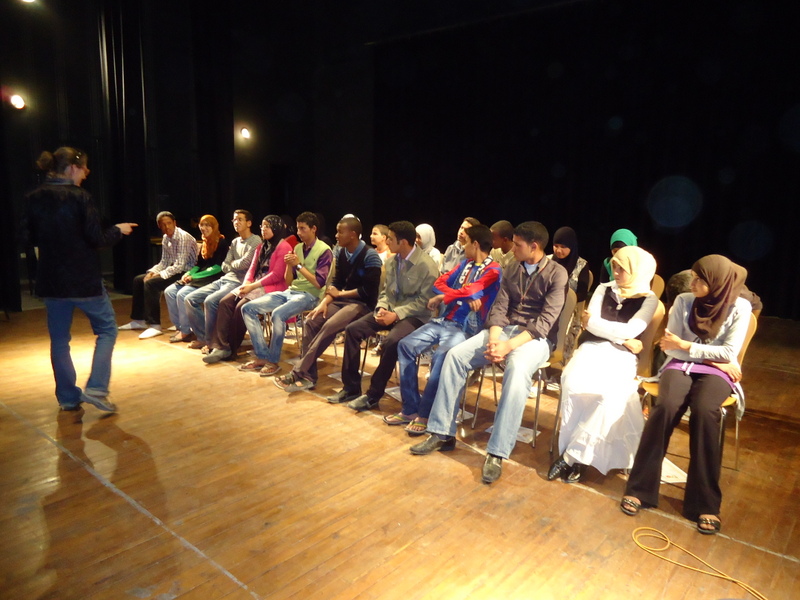
The first ever Spelling Bee Morocco championship was held May 25 & 26 in Ouarzazate and was deemed a success by nearly everyone. We crowned champions in two events – the team bee and the solo bee. While it is great to introduce a new kind of event for Moroccan students and provide a touch of Americana, what is most rewarding to me is the emotional and psychological impact of the event.

Ibtissam Boulaghmane, the solo bee winner, told me after her victory that she had never won any medals before,  that she was not good in sports, so she had never been able to compete for anything. But she won two at the finals – first in the solo bee and second in the team bee - and one at her City Bee. Plus the trophy, of course. She added that it was great to meet all these other kids, too.

At lunch, after the final event, as they were going around the table, telling me what their plans for next year were, one girl said, “This is it for me. No matter what happens on my baccalaureate exams, I am done with school. But what a way to finish! I will remember this for the rest of my life.” The other kids chimed in and told me her father and brother insisted that she stop school and adopt the traditional woman's role, which means she will live and work in her father's house until (if) she gets married.

Three 11th grade girls won the team competition.  They
renamed their team "Heroines" after the win.
Despite stories like that, the role of women in Morocco is changing. One of the gratifying things about the Spelling Bee Morocco project to me is that it provides an opportunity for girls to compete with boys on the same playing field. And in this case, they excelled. Of the 27 qualifiers for the finals, 20 were girls. And all the champs were girls.

Another deeply satisfying aspect of the competition was that my younger son Joe helped me out a lot. He was in the country, visiting and traveling. He accompanied me to several of the trainings I gave to Moroccan teachers.

On one we went to Zagora, a southern city on the edge of the Sahara. Even in the spring it was very hot. In earlier days, it was the traditional staging area for camel caravans and boasted a famous sign saying “52 days to Timbuctou.” We also had a memorable day at the training in Kalaa, across the river from my village. It rained hard during the training, and it rained in the mountains. By the time we were done, the river had flooded and the road bridge was washed out. But the transit driver knew of a place a few miles north and dropped us of there. Following the lead of a few other locals, we tramped for an hour through flooded muddy fields in the near dark until we did, indeed, come upon an intact cement footbridge. Once on our side of the river, I soon realized we were on a road familiar to me from my running. The rain had stopped, and we had a pleasant hour's walk home along the dirt road lit by a starry sky.
My son Joe served as score-keeper for the finals.

Joe enjoyed the experience, too. When we were making arrangements for his flight home, he said, “I'd really kinda like to stay for the regional finals.” So he did, and he served as the official scorekeeper.

His involvement served another benefit, too. The day after the finals, a teacher who had been at the Kalaa training as well came up to me and said, “I want to tell you how good it was to see you and your son working together. We've been talking about this. You know here in Morocco we have the impression that in America, when kids are 18, they leave the home and don't come back again. Maybe they call on the phone once or twice a year, but don't come home. Now we see that's not always true.”

~~~~~~~~~

Tidbits:

It's hot here now. In my courtyard (usually a relatively cool place), it gets into the 90s during the day. Outside, in the sun, between 110 and 115. I bought a fan. It helps.

I had my mid-service medical exams in Rabat a couple of weeks ago, and all is well. Hard to believe I've been here this long – 16 months, actually.

I've continued work on Spelling Bee Morocco, planning for our expansion next year into other regions of the country.

In a week, I'll be leaving for a two-week vacation in Germany and the Czech Republic – Berlin, Dresden, Prague. Really looking forward to it.

Wednesday, May 23, 2012

How I Spell Work

When I’ve cried “busy” in recent blog posts, what I’ve been alluding to is Spelling Bee Morocco™.

It’s a project of mine that has taken up the lion’s share of my time since last December and involved a number of my PCV friends as well – Ryan Scheidt (website), Mark McEnery (graphic design), Mimi Duong and Fauve Johnson (City Bee organizers), and Maureen Sieh (connections and press coverage) – and many others who’ve pitched in here and there. The idea came from another PCV, Ben Pennington, who finished his Peace Corps service last October and is back in Tennessee writing, reading, and making music.

Trophies and medals for the
 City and Regional Championships

Morocco is a land of many languages. Most people speak a dialect of Berber (there are three main ones, including Tamazight, the one I speak) or Darija, the Moroccan dialect of Arabic. In school, they are taught Modern Standard Arabic from the 1st grade on. They begin French in 3rd grade.  In recognition of the role of English as the current lingua franca of the world, the Ministry of Education mandated the offering of English about 10 years ago. But it does not begin until 9th grade and lasts only four years and there just aint much English spoken here.
So Spelling Bee Morocco™ aims to promote and popularize the use of English – through play, not testing. As a uniquely American creation, spelling bees also offer opportunities for cross-cultural education. Spelling Bee Morocco™ has two main activities – a competition and a website. The competition provides motivation and recognition for Moroccan students of English. The website provides information about the competition, but, just as importantly, it functions as an ESL resource for students and teachers all year long. The Spelling Bee Morocco™ competition is open to students through 12th grade.
During the practice round at the Kalaa City Championship
We’ve partnered with the regional chapter of MATE (Moroccan Association of Teachers of English) for Ouarzazate, Zagora, and Tinghir provinces. Our hope is to develop a program that will become national in scope, but this first year we decided to restrict it to the region, get some experience, and work out some details. This is what we’ve done so far:
·         Developed a website and created a Facebook page
·         Applied for and received a grant from WorldConnect/Kids2Kids to support the cost of City Bees and the Regional Championship
·         Held five trainings that introduced the spelling bee concept (pretty much unknown in this country) to about 50 teachers
·         Registered 25 schools, which finished their school championships earlier this month
·         Held four City Spelling Championships, which were completed last Sunday.
And this is what remains to be done:
·         Hold our Regional Championship in Ouarzazate, the largest city in the region.
·         Start all over again. Things have gone well enough so that we think we can expand it - and that's a whole new ball game.
Checking to make sure all spellers are in order in the
Solo Bee at the Kalaa Championship
Despite the challenges of introducing a new concept, working long-distance, organizing a multi-part event, trying to work to a schedule in a country where serious planning seldom seems to extend more than a day or two in advance, it has gone pretty well. On Friday and Saturday, May 25 & 26, twenty-seven of the best spellers in southern Morocco will converge on Ouarzazate for the first ever Spelling Bee Morocco Championship. As in the States, talent and desire will tell. The group includes one ninth grader. The remaining spellers are split about evenly among 10th, 11th, and 12th graders. The spellers will compete in two events, a team spelling bee and a solo spelling bee. Teams of three spellers each from five schools will compete for the team title. Seventeen spellers will vie for the solo title.
I’ll be sure to let you know how it all turns out. In the meantime, you can follow “Spellbound,” the blog for Spelling Bee Morocco™  by providing your email in the app on the blog page. You can now also follow us on Facebook. Please go there and “like” us.
And now…I’m busy. I still have a championship word list to create.
The top finishers of the Kalaa City Solo Spelling Bee

Monday, April 23, 2012

My Own World Book Day


Happy World Book Day to everyone!
As a person who worked in the book business for 37 years, most of my working career, this is a day that is close to my heart. There are several things that make it especially dear to me this year.
The first is that the U.S. has adopted a great idea from the U.K. and created World Book Night, run by my old friend Carl Lennertz, one of the great enthusiasts for books in the U.S. On this day, 20,000 people in the U.S. will give away 1,000,000 books to whomever they choose. What a great way to share the love of reading and show how you value the worth of books. You can see the list of books being given away in the U.S. at the World Book Night site. And here’s a link to the U.K. site as well.
The second is that Ann Patchett, one of my favorite novelists – and also a bookseller – was named one of TIME Magazine’s 100 Most Influential People in the world for 2012. In an op ed piece in the NY Times recently, in which she lamented the Pulitzer Prize committee’s decision not to award a fiction prize this year, she wrote this:
Reading fiction is important. It is a vital means of imagining a life other than our own, which in turn makes us more empathetic beings. Following complex story lines stretches our brains beyond the 140 characters of sound-bite thinking, and staying within the world of a novel gives us the ability to be quiet and alone, two skills that are disappearing faster than the polar icecaps.
Joe reading Neil Gaman's American Gods in my courtyard

The third is that my son Joe is visiting me, and he spends a significant chunk of every day with his nose in a book. It warms my heart that this boy – now man – that I read with every night for the first 13 years of his life has rediscovered reading. What adventures we had – Tin Tin, the Little House books, the very first Harry Potter book – too many to list. And what good times we’re having now as we each talk of the books we’re in. He recently finished Heinlein’s Stranger in a Strange Land, Heller’s Catch-22, and Neil Gaiman’s American Gods, and has just started Murakami’s Kafka on the Shore.
And the fourth is that, after living in a small village in Morocco for a little over a year now, I see even more clearly the important role that books play in changing individual lives, culture, even a country. In my town, except in my own house, only one time have I seen a book other than a textbook or a Koran. I have never seen a person reading for pleasure, or, for that matter, even for information. This is a good town, with good people, but it is also a town with a narrow vision, and a short vision.

This “bookless” culture is not confined to small villages. The city of Agadir, with a population of about 700,000, does not have a public library. In most schools, the libraries, if they exist, are locked most of the time and primarily contain textbooks. A recent report found that Moroccans spend an average of only 1 dirham (about 12 ½ cents) on books a year, and only 1,000 new books are published in Morocco each year.

Fatima "reading" Goodnight, Gorilla, by Peggy Rathman
in Tamazight to a couple of local children

But there are individuals, of course, who are fascinated by books. I’m speaking mainly of children who, like children everywhere, thirst for stories – stories that help explain their own lives to them but also, in Patchett’s words, help them imagine lives other than their own. And there a few adults, too. In my village, I’ve found one so far (there may be others) - Fatima, one of my host sisters. In February, on my return from the Marrakesh Marathon, I gave Fatima and Sulayman, my 6-year-old host nephew, each a book in Arabic – the first book either of them had ever owned. So that was my World Book Day, I suppose.
Since then, I’ve gotten a few wordless (or nearly wordless) books from the States. Fatima has become the storyteller, supplying a Berber text to these wonderful stories. My plan is to create a library here in my village in connection with the women’s association I work with. I’ll tell you more about that in a future post.
I guess the best way to close is to mention what I’m reading. I recently finished, Cry, the Beloved Country, and Things Fall Apart, two African classics which, aside from their intrinsic beauty and power, help me understand a little bit better what I’m experiencing here in Africa. I’m currently reading Arabian Nights and Days by the Egyptian Nobel laureate, Nagoub Mahfouz and a very funny unpublished novel, A Speckled Axe, by James Quackenbush, a friend of mine.
~~~~~~~~~~~~~~~
I didn't want to begin with an apology, but I know I'm waaaay behind in posting to this blog. I've been busy! And I have lots to tell! And I will soon...insha'allah.

Tuesday, February 21, 2012

A Moroccan Hoodie and Other Stories

I’ve been remiss in making posts to this blog. Good reasons – I always have good reasons – but you don’t want to hear my excuses. Today, I’ll try to bring you up-to-date on my life for the past five weeks, saving details on my work and travels for separate posts.
The Travel Bug
It’s a kind of illness – a delicious kind of illness – this travel bug. When I got back from my vacation on the Atlantic coast in early January, I fully expected to launch into my work and get a lot done. It turns out I was not as productive as I’d expected to be. The trip had rejuvenated me, yes, but it also infected me with the travel bug. I spent a lot of time researching and planning future vacations – Central Europe (Berlin, Dresden, Prague, Budapest), Turkey and the Balkans, sub-Saharan Africa. At least one of those trips I will surely take. Others will remain – like most thoughts of travel – on the shelf of dreams.
Cookie Baking

Sulayman decorates a star

In mid-January, I had a baking party with my host sisters. They’re very good cooks, but for a variety of reasons do little baking, except for bread, which they bake every morning. They loved the cookies I served at our Christmas celebration and made me promise to show them how to make them. On January 22, Aicha, Ouardia, Fatima, and Sadiya, along with her children Sulayman and Ayman, came to my house. I served them lunch of chili and corn bread. Corn bread they’re familiar with. The chili was new, but they loved it – it has lots of meat, after all! And then we spent the rest of the day making oatmeal cookies and baking and decorating Christmas cookies. What fun!

The Marrakesh Half-Marathon
Adam and me after the race
Near the end of the month, a PCV friend, Adam Richie-Halford, and I went to Marrakesh. The first two days, we worked at Marche Maroc, an event put on several times a year by PCVs in the Small Business Development sector for the artisans they work with. There were workshops in the morning; in the afternoon, the artisans sold their wares from booths set up on the margins of the famous Djemaa el-Fna. On the third day, Adam and I ran the Marrakesh Half-marathon. It’s the longest race I’ve run in many a year. I was happy with my result – I finished, I never walked, and though I felt the effects for the next day or so, I had no injuries. And I ran a respectable time for me – 2:09:05, a little under a 10-minute per mile pace.
When I got back home, my family was very interested in my photos and my participation medal. “What place did you get?” one asked. I didn’t understand. “First, second, third…?” “Oh, two thousandth,” I replied (actually, I lied a little – it was more like 2,164th, but that number was too difficult for me to figure out how to say). First, there was a look of incredulity, then a roomful of laughter. The look of incredulity surprised me a little. What did they expect from a 67-year old? But then I think of people’s reaction to me when I’m out running in the country. They often will point out a short-cut to me, or invite me to stop for tea. I think most of them have a hard time grasping that I’m running in order to run, not to get somewhere. By the same token, I think my family had a hard time grasping why I would run in a race if I wasn’t trying to win. But they liked the medal and the pictures.
My Moroccan Hoodie
Me in my bespoke tajlabit
Every now and then through this cold dry winter, I’ve seen a tajlabit made of a salt & pepper weave fabric (ašhعabi) that I really liked. Whenever I asked where I could get one, people would tell me I needed to look in a fabric store. I did that, to no avail. But while I was working at Marche Maroc, I made some purchases to help support the artisans. I’d just bought a bottle of argan oil for my host mother and father, and I looked up and saw a bundle of fabric in the adjacent booth. It was just what I’d been looking for. I went over and admired it. It turned out it was made from hand-carded, hand-spun, hand-dyed, and hand-woven wool. I asked her if it was enough to make a tajlabit. Yes, she said, three meters, the standard. I bought it. When I got home, my host father took me to the tailor he goes to. After some oohing and aahing from the tailor, which reassured me about the fabric, he took my measurements. Three days later, I had my own salt & pepper, winter-weight tajlabit. There was enough fabric left over for him to make a hat (tarbush) for me. I’ve never had a hand-tailored piece of clothing before, but now I have a completely hand-made piece. I can tell you, it’s quite warm as well as handsome.


Friday, January 13, 2012

Three Cheers for American Bureaucracy!

Our country director sent out her weekly update today. In it was a link to the FVAP – Federal Voting Assistance Program. It’s a program designed to help Americans living overseas in the armed forces or any other capacity exercise their right to vote. I went online and filed my request for absentee ballots for all of the elections in my voting district for the upcoming year. I was able to select a preferred method of delivery – email, mail, or fax. It was simple and fast – about two minutes.
Except for applying for passports, I didn’t have many encounters with government bureaucracy until I reached the age of 65. Then came Medicare and, a year later, Social Security. I have to say that all my dealings with those agenciess have been positive. Efficient, friendly, helpful, and respectful people and pretty straightforward and clear procedures. And now this. It’s enough to make a citizen happy.
I compare that with my experience here in Morocco.
After I was sworn in as a Peace Corps Volunteer last May, I had to apply for a carte de sejour (residence permit). That required 10 passport sized photos (can’t imagine why, since the card itself has only one), an equivalent number of photocopies of my passport, attestation de travail (work certificate) and attestation de residence (certificate of residence), several tax stamps, three trips to the Royal Police office (gendarmerie), and one to the city hall to get all of them notarized. After I finished the application, I received a receipt, which I had to carry with me at all times. During the period while I was waiting for my card, I had to return and get the receipt renewed every month. That took five months, which meant five more visits to the gendarmerie. For me, that meant only about three hours out of my day each time. I’m fortunate. For some of my Peace Corps friends, that means a whole day and travel by bus or taxi to a distant city. I’m also required to inform the gendarmes whenever I’m going to be away from my site overnight.
So I say, “Three cheers for the American bureaucracy!” It’s a snap compared to what I face here.
P.S., I didn’t really forget that I have an encounter with the bureaucracy every year on April 15. I’m not really looking forward to filing my taxes from Morocco for the first time, but I actually think it’s going to go all right. Filing taxes is not so straightforward. Like many people, I get help with it. But, you know, that’s not really the fault of the bureaucracy. It’s the fault of those politicians who, as either policy or payback, have created all the windfalls and loopholes in the tax code.

Monday, January 2, 2012

Christmas in Morocco

My artisan-made cookie cutters
When I first tried to explain to my host family that Christmas was coming, they said “Bonani?” I did an off-the-cuff etymology of the word and figured it was a borrowing of the French bonne nuit (good night). So I said, yes, I thought so. Of course, I was wrong. It’s actually a borrowing of the French bonne annee (Happy New Year).
For several days we went along in blissful misunderstanding. When I finally realized the mistake, I explained to them that, no, Christmas was a different holiday, always a week before bonani, and it was big, the biggest American holiday of all. I said it was comparable to Leid Axatar. My host father said, “Do you slaughter a sheep?” I said, no, that we traditionally eat turkey. “Skram,” he called me – “cheapskate.” We had a big laugh.
A plate of cookies I made up for Sulayman, my host nephew,
who was still at school when the party started
But I set about preparing a celebration for Christmas, which was clearly totally unknown to them – in fact, I have yet to discover what the word for it in Tamazight is, if it exists at all. A friend in the States sent a tiny tree with tiny lights and tiny ornaments. I had one of my dagger-maker brothers make some cookie cutters for me. Two of my Peace Corps friends came to my house and helped me get everything ready for the little feast.
The afternoon of the 23rd, my host family (10 of them, anyway) came over. We had Christmas music playing and served cookies (frosted Christmas cookies, oatmeal, and jelly-filled) and apple cake, along with hot chocolate. After eating, I explained that gift-giving was also a Christmas tradition. I gave them each a pair of good socks filled with apples and oranges, M&Ms and candy canes. They were thrilled. “Not skram,” my host brother said.
My tiny tree with some presents for America around it.
The next day, one of my friends and I went to another PCVs house to celebrate the holiday with Americans. There were seven of us in all. We each contributed a dish and had a real feast – a chicken tajine, mashed potatoes, green beans, deviled eggs, cauliflower-cheese pie, apple cake and apple sauce. We went for some long walks in the countryside around their house and played games. I must say, it’s fun and a great comfort to be around countrymen and women at times like this.
On the 27th a friend and I took off on my first real vacation in Morocco. I’ll fill you in on that in my next blog. I know I keep promising that. This time I’ll keep it.
Bonani!
A potted olive tree with homemade decorations made a
great stand-in for an evergreen at our PCV Christmas

My contribution to the Christmas tree decorations


Our PCV group on one of the hikes

I visited a manger and found sheep. The mother fretted
a bit.

Our PCV feast.

Friday, December 9, 2011

Surf, a Spelling Bee, and IST

Sunset over the Atlantic
We arrived in Mehdiya last Sunday after dark. Though I couldn’t see the ocean, I could smell it. When I went to sleep that night, I went to sleep to the sound of surf for the first time in nine months. And when I got up in the morning and looked out my window I saw a broad beach, a long breakwater reaching out into the ocean, and what looked like a dredge working at the mouth of the channel. It reminded so much of Grand Haven and my home on Lake Michigan.
Walking the beach with a friend, Adam, during
lunch break
The fifty-two remaining volunteers of the 60 who started with me (eight have ETd – early terminated – for personal or medical reasons) all converged on Mehdiya, a beach town a little north of Rabat. The occasion was IST (In-service Training), held six months after swearing in for each staj. On our first day, we had another LPI (Language Proficiency Interview). I did all right, moving up one notch to Intermediate Mid. At least I’m moving in the right direction! The next day, we shared our experiences so far and our plans for the next phase of our service. That was followed by a couple of days of workshops on grant-writing and teaching ESL (English as a Second Language).
I feel lucky. Many PCVs are still “integrating,” but I have plenty of work with my three days a week teaching in the elementary schools, plus work at the sbitar, middle school health club, and with the women’s association I’m helping get started.
Going through the rules prior to the start of the
IST Spelling Bee
I’m also working on a new project – Spelling Bee Morocco – that I hope will eventually create a national spelling bee for Moroccan students. I used the gathering at IST to present the idea to my fellow PCVs, and we held a late-night Spelling Bee at 10:00 p.m. on Wednesday. Fourteen PCVs participated and about 20 others formed an audience. Much to my surprise, very few of them had ever participated in a spelling bee back home. But they’re a bunch of smart, confident people, and they really got into it. It took eleven rounds to crown a winner. She won on “hippopotamus” and “aggraded” after the runner-up stumbled on “euphemism.”
The winner and a disconsolate runner-up
IST has ended. We’ve just had dinner. There will be a “Souk Prom” later tonight. And tomorrow morning, we’ll all head back to our sites. This is the last time all of us will be together at the same time until our COS (Close of Service) conference, a few months before we complete our Peace Corps service, so there’s a bittersweet tinge to the evening.
I spent a day in Marrakesh on my way here, and I’ll be spending a couple of days in Rabat on my way back home. I’ll tell you all about that, and some other travels I’ve taken in the last couple months, when I get back to my site next week.

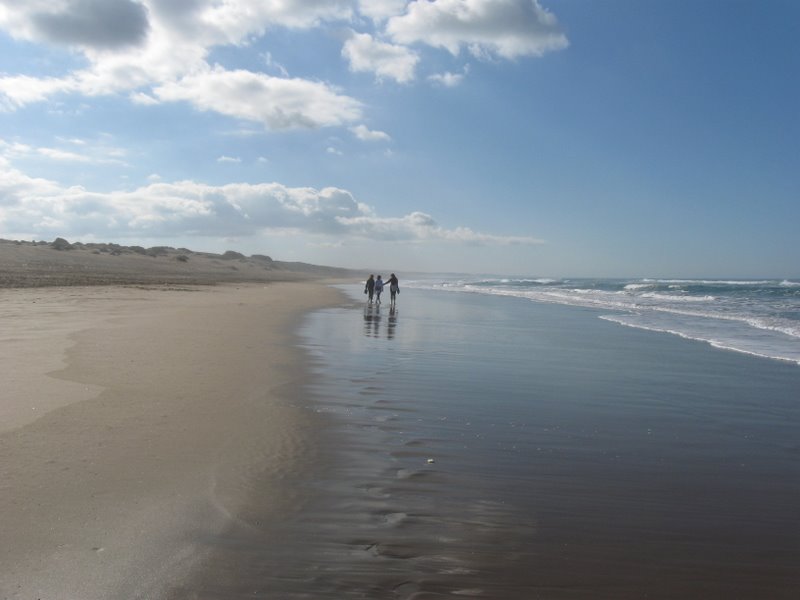
Mehdiya has a beautiful wide, flat beach


Work boats entering the channel at dusk